
Posted in What I've Used

What I’ve Used 03/2020

In Support of Flashcards

5/5

This may seem as a departure from the books and services that I have been talking about, but I cannot stress enough using Flashcards as a test prep tool. I know that there are many flashcard applications out there, but I prefer and recommend making ones own flashcards. I think that writing the cards helps through repetition to sear the words into memory.

I contribute making flashcards to a good the score I was able to manage while taking Network+ around this time last year. I did better on that exam than I did on Security+ (though I passed that as well) and I think flashcards made the difference. So, for Linux+ and beyond I’m back on the flashcard train.

I would also recommend the spiral-bound cards or mini-cards as they make flipping easy, though regular cards makes it easier to separate out concepts you: a. know b.kind of know c.don’t know at all.

These repetitive words and phrases are merely methods of convincing the subconscious mind. 

Claude M. Bristol
Posted in What I've Used

What I’ve Used 02/2020

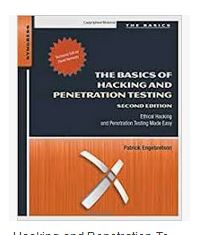
The Basics of Hacking and Penetration Testing – Second Edition
By: Patrick Engebretson [Syngress]

I started this book before finishing the class I took for Cyber Attack and Defense in which in pairs we had to work through penetration testing methodology on a machine chosen from Vulnhub. I just finished it a few days ago, not because it is in any way dense or hard to follow, but because of time management.
Regardless of my shortcomings, this book is exactly as the cover states: The basics.
This book is highly recommended a beginner guide for anyone who is new to hacking or penetration testing. The penetration testing methodology that I spoke of in a recent post is clearly laid out in this book and chapter by chapter Engebretson, walks-through these steps and explains the tools to use and the basic ways in which to use them. There are also chapters that delve into Web Application Hacking and a brief touch on Social Engineering with SET (Social Engineering Toolkit) which were very informative.
I found myself highlighting throughout this book to come back to quickly for my next CTF. It’s a good start into learning these tasks and is excellent in that it sticks with emphasizing a structured approach to penetration testing and hacking. It wouldn’t be good for people who have been doing these tasks for any length of time, but for the intended audience it is definitely worthwhile.

5/5

Cover Image
Posted in What I've Used

What I’ve Used 01/2020


Score: 4/5

Cybrary.it is one of the first sites that I really got into using when I started dipping my toes into learning cybersecurity/infosec/info tech. This was before they started with the Cybrary Pro tier, so I started when all they had was free, but now I am a Pro/Insider member.

The free tier offers access to numerous videos, guides, and the Open Blog which is nice to read up on what others are trying and learning. This tier though is limited in scope and sometimes the information is slow to be updated.

The Pro/Insider tier offers all that the free tier offers, as well as: career learning paths, labs, practice tests, first access to on-demand videos, mentors, access to the slack channels, etc. The cost is worth it especially if the company will cover it, but if you do most of your learning out of your own pockets (like myself) then try to catch it on sale (Like it currently is).

I’m currently following the SOC analyst pathway with a lot of side classes that I keep adding to my queue as my interests are piqued. I also use the platform to do pre-tests for my certifications to focus my studying/practice so I can concentrate on the items in which I’m weak.

I think that this site is a valuable tool for anyone that is learning in these fields, especially if they “self-taught” or need supplemental resources. I wouldn’t necessarily say that the Insider level is required, but it is in my opinion it has thus far held value in my studies and catching a sale or discounted price has not be especially hard.

The main issues I have with the site are that some of the videos have sound quality issues. The CYSA+ course suffers from the classroom style environment in my honest opinion it was probably my least favorite video set that I’ve taken from Cybrary. I still would recommend the site as a good source just from the amount of content that is available.

Posted in Uncategorized, What I've Used

What I’ve Used 12/2019

CompTIA CSA+ Study Guide

By: Mike Chapple and David Seidl
Published by: Sybex, Inc.

The thing I like most about this particular guide is that it has Labs for each chapter, I think this is important as it gives the reader/learner a hands on approach to learning. This type of hands-on can possibly help them when taking the exam because CompTIA exams always have a few scenario questions.
The version of the book I used for studying was the pre-release before the name of the exam was changed to CYSA+, but that is because this newer test has fewer options for study materials than older exams such as Network+ and Security+.
I’m taking the beta test in the first week of January, so wish me luck. (3.6/4)