I know that there is no point in which in this field you will have learned everything. There is no end point in Information Technology, Cybersecurity, Programming. There are constant innovations and learning is pretty much lifelong. That being said sometimes it can be a little overwhelming when you think about all of the things that interest you. I know that there are numerous things that I want to get some hands on experience with and sometimes I get anxiety about not doing enough towards learning these things. This is probably one of the reasons that I have a plethora books on all the subjects that interest me so that I can get to them when I have the time. I think maybe the most important two things is to keep track of the items that interest you and also not stress the timeline so much, try to make a general goal/outline of steps to take in order to accomplish learning the things that interest you.
“Absorb what is useful, reject what is useless, add what is specifically your own.”
Hack Metasploitable 2 and Hackfest 2019 from VulnHub
So, before I set the tone that I just am not a “group work” type of person let me just say that this past Fall 2 semesters (2019) I had the best group experience. It does happen, if all member care equally as much about the grade and are just as interested in the topic.
We were tasked with choosing a Virtual Machine on VulnHub and using the Penetration Testing Methodology to work through finding and exploiting a vulnerability in order to gain access to the machine. We were doing this in conjunction with classwork wherein we worked through doing the same using Metasploitable 2 as the target machine.
So, let’s work quickly and briefly through this, because like some other beginners it helps to know that there is a method to the madness and following said method aids in keep any penetration test on track. If you don’t you’ll be like me during the NCL CTF bashing your head against problems as if that’s the way to solve them.
Penetration Testing Methodology
Planning
For this step the parameters of the assignment were given to us. Work through the methodology steps in order to gain access to the given machines.
Reconnaissance
This step was accomplished through various Nmap scans. This is easier for Metasploitable 2 than it is for HackFest 2019 because with Metasploitable one can login to the machine and then run ifconfig to get the machine’s IP address. With the HackFest Machine you cannot login because credentials are not given to you. There are 2 ways that I know to solve this problem: easy and cheat.
The easy way is to use your source machine (hopefully Kali or Parrot) and run an Nmap scan against the broadcast IP of the network [this only works if both machines are on the same network, this is certainly more difficult in the wild, but easy in a VM Lab Set-up on their own network]. You can get the broadcast IP by running ifconfig on the source machine and noting the broadcast IP in the first line.
nmap XXX.XXX.XXX.0/#
Nmap example to scan an entire subnet to find the target’s IP address
The Cheat is by bringing up the machine’s information in the Virtual Machine Application both VirtualBox and VMWare will tell you the IP address assigned to the machines.
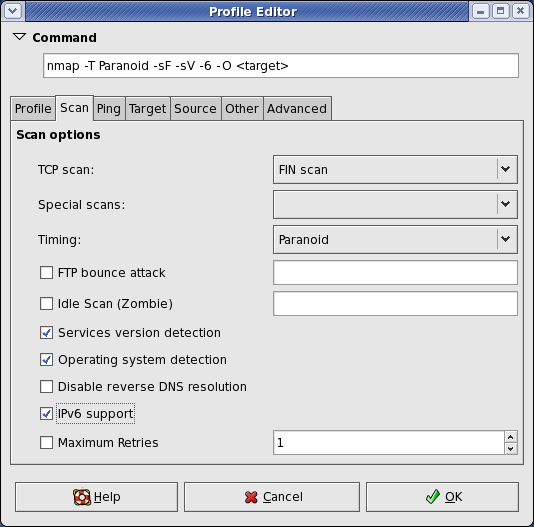
Once you have the IP address for the target machine then use either Nmap or Zenmap to scan the target. It might take a couple of scans to get both UDP and TCP open ports and all the running services. I’ll show the scan commands, but we used Zenmap which craft the commands based on the scan that is chosen and then the scans can be saved using a dropdown menu.
Useful Nmap Scans at this point (note that these can be combined into fewer scans):
nmap -sT IP_Address (TCP connect Scan)
nmap -sU IP_Address (UDP ports)
nmap -A -sV IP_Address (Standard OS and Service Detection)
nmap -p- IP_Address (Scan ALL Ports)
Vulnerability Analysis
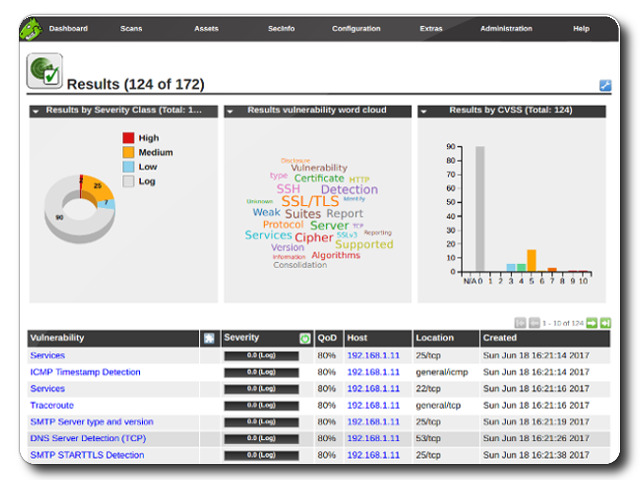
When we finished with the scan we’re left with a good bit of information, a whole list of ports that appear to be open. There’s also some information on the Services running on these ports and the Operating System running on our machine. Depending on what’s running and the command used we can also get some additional information regarding scripts or insecure passwords or encryption being used. With this port information we have a narrower view of what or where or vulnerabilities might lay. These initial scans give us a little bit more direction. I think of it as being in a long hall lined on both walls with a bunch of doors. The Nmap scan would be making all the ones that cannot open disappear. The OpenVAS vulnerability scan in a way tells you which are the easiest to open. I won’t go through setting up OpenVAS because there are better guides than mine that walk-through doing this. We used the web interface to run our scans, sometimes it seems a bit clunky and can be slow, but for beginners it’s pretty simple to navigate. Set the IP of the target machine as the target and run the scan. Ours took anywhere from 30 mins -1 hour to run our scans. After the scans are run we get a good bit of information including a CVSS Base Score (0-10.0: None/Low-Critical) for the Machine and a list of vulnerabilities on the machine. Each vulnerability is scored, some have remediation steps if there are any, and most tell the user how the vulnerability might be exploited.
Exploitation
Now we know which doors can possibly unlocked, we just have to find the door that leads to where we need to go (usually privilege escalation) and not the ones that lead to the broom closet. Although it is worth it to use the Metasploit Framework to work through exploitation on the Command Line again we’re new and in this class we used Armitage. I’ve done work in a previous class using Metasploit; Armitage is definitely easier. Armitage can take in your saved information from Nmap and OpenVAS and check for exploits and it can run automatic exploits to see if any work. Again, I’m not going to walk through setting up Armitage because this has been well traveled on the internet: here or here.
I will say that my partner also used WPScan because HackFest 2019 has a WordPress vulnerability. I didn’t so I’m not going to walk through that, but I’ll point you in the right direction for it.
Metasploitable 2 does not have a Word Press vulnerability. I won’t tell you where or which vulnerable connection, but there is a certain exploit that leads to a connection in which it is simple to escalate privilege to root and steal the shadow directory.
Promise, if I can do this, you can!
Post-Exploitation
One of the main activities at this point is to conduct some password cracking. We have the shadow directory information which should contain some usernames and hashes. Copy these into a text file and with Johnny (the GUI for John the Ripper) feed them in.
Reporting
Reporting might be a difficult part for some, but this really was the part to me where I shine. There are numerous examples of reports that can be found online. Also, how you write your report as far as content could depend on a number of factors including:
The context of the testing (parameters and the like)
The number of machines being tested
The requests of the “client”
The different methodology formats that one might follow; such as if following an outline by certain committees or “certifying” bodies.
It’s important that the report be detailed, but approachable. It also needs to include recommendations for remediation as well as all proof that the vulnerabilities and the exploits exists. For class we had screenshots, but it it was a professional report this might not work as well in the middle of the paper, but rather in an appendix or exhibit at the end.
It is recommended by most professionals that one learn to do these things on the command line and not focus on the GUI, but I find that it is valuable to be able to do both. I am more comfortable with the GUI though.
So, this will probably be a short post. I have just started the last class for the bachelor’s part of my dual degree (I know that some will say that going to school for cybersecurity is unnecessary, but I thrive in classroom settings or with direction). I’m antsy about finishing this part of the program. Honestly I’m a slight bit overwhelmed by the work as well. We’re suppose to finish a professional resume, a portfolio, a group project (group projects are the worst and online groups projects are like the 3rd level or hell), and an exam with a java programming portion. Sure, there are 15 weeks to complete all of that so it’s doable, but it’s still a bit nerve wrecking. I’m so afraid of failure it’s not funny. But, it’s better for me to admit that I’m scared than to act like I’m not scared. I just need to keep telling myself that I can do this and take it all week by week.
(Late because I took CYSA + Beta on Thursday 1/09) [Fingers-Crossed]
I think people direct people to “find what they love and do it…” They say that as if doing that is just the easiest thing, but sometimes it isn’t. For example the number of things I thought I really wanted to do and then finally realized I wasn’t suited for or I really wasn’t as interested in are too numerous to list here. I will admit that it is important to find the things that you are most interested in because it makes you want to learn more about it. Although, there is often things that one has to learn in order to move forward or change careers or what have you, it’s also important to kind of focus in one the things that really interest you and learn about them.
Peerlyst
For me, Digital Forensics and Penetration Testing is one of the subsets of Cybersecurity that really interests me. I may have to learn to do SIEM investigations and log analysis for work, but learning these things isn’t a passion project for me, it’s a means to an ends. These things are still interesting , but when I learn them it’s not the same sense of pride or what have you as I feel when I uncover something or even when doing a CTF.
CompTIA
I 100% am not set on what exactly what I will be doing in 5 or 10 years. Because my path has diverged so often and in such varied ways I try not to make solid plans, but rather have an outline of things I would like to learn or do. Whether that would work for others isn’t for me to say. I just know that I tried to rigid planning thing and that didn’t work for me at all. The unplanned plan does work.
SANS
My best advice would be to learn, to be open to learning and always be researching shifts and changes and developments and then just to absorb the things that interest you the most and see where these things might take you.
Cybrary.it is one of the first sites that I really got into using when I started dipping my toes into learning cybersecurity/infosec/info tech. This was before they started with the Cybrary Pro tier, so I started when all they had was free, but now I am a Pro/Insider member.
The free tier offers access to numerous videos, guides, and the Open Blog which is nice to read up on what others are trying and learning. This tier though is limited in scope and sometimes the information is slow to be updated.
The Pro/Insider tier offers all that the free tier offers, as well as: career learning paths, labs, practice tests, first access to on-demand videos, mentors, access to the slack channels, etc. The cost is worth it especially if the company will cover it, but if you do most of your learning out of your own pockets (like myself) then try to catch it on sale (Like it currently is).
I’m currently following the SOC analyst pathway with a lot of side classes that I keep adding to my queue as my interests are piqued. I also use the platform to do pre-tests for my certifications to focus my studying/practice so I can concentrate on the items in which I’m weak.
I think that this site is a valuable tool for anyone that is learning in these fields, especially if they “self-taught” or need supplemental resources. I wouldn’t necessarily say that the Insider level is required, but it is in my opinion it has thus far held value in my studies and catching a sale or discounted price has not be especially hard.
The main issues I have with the site are that some of the videos have sound quality issues. The CYSA+ course suffers from the classroom style environment in my honest opinion it was probably my least favorite video set that I’ve taken from Cybrary. I still would recommend the site as a good source just from the amount of content that is available.
It is the end of 2019 and like most I want to take a moment to reflect on all the things that I actually have accomplished this year. Sometimes we can think too much about where we aren’t that we don’t focus on where we actually are and how far we have come. At the beginning of this year I had just changed careers and I was a little unsure of where or if I actually fit in. Now, I’m more self-assured and confident in my ability to learn and retain new things and the “rightness” of this course .
Accomplishments
Passed Network+
Passed Security+
Participated in First CTF (Individual and Group)
Started a Blog
Delved more into Cryptography
Cracked a Password
Finished my First Year in a Cybersecurity Position
Attended my first Cybersecurity Conference (Hacker Halted in Atlanta)
Finished Undergrad work (Only have my Capstone left)
But, it’s also good to look back at how we might have failed because epic-ly failing is how we level-up epic-ly.
Failures
My First CTF was a Bull in a China Shop Scenario
The Group work was worse; most of my group work across categories was kind of a bust (Pen-testing Methodology for a Class was the 1 exception)
Really buckling down and learning Linux…
”Self-awareness gives you the capacity to learn from your mistakes as well as your successes.”
—Lawrence Bossidy
Upcoming….
CYSA+ (Taking the Beta in a few days…[crossed fingers])
Linux+ (Voucher has already been purchased)
Finish Undergrad and move directly onto Graduate Coursework
Build out Security Lab
Put a Dent in My InfoSec Book Collection
Get Better at Networking…
“The future rewards those who press on. I don’t have time to feel sorry for myself. I don’t have time to complain. I’m going to press on. “
“It’s not too late to start! Start right now anyway. Set goals and take action. Have courage to fall, fail and suffer. Don’t quit. Persist with courage. Success will achieve anyway and be yours 100% guaranteed.”
― Lord Robin
I started really getting into tech when I was working overseas. I had soooo much time and needed something to stimulate myself. Also, I knew that the work I was doing was temporary and I needed to make a way so that when I came back I wouldn’t have to go back to my previous position. The first steps I took was trying to learn to code/program So many of my first resources are geared towards that.
By far the easiest method of getting a cyber lab up and running is using virtualbox or vmware. I’m partial to virtualbox because it’s free and my pockets love free. Using virtualbox one can build out a connected network that is separate from their actual machine (connection-wise). Using one or more of the vulnerable VMs on Vulnhub they can also test out and learn how to conduct a penetration test/hack a machine. They say the best way to learn is by doing. So, my first cyber lab has been through virtual machines. There are a number of good/great youtube tutorials on how to set-up VMs for a cyber lab so, I’m not going to rehash that. I will link to a couple that I found particularly helpful with this iteration of my lab:
The reasons I went in this direction for my first cyber lab is because it’s cost effective and easy to set-up, maintain, and ultimately breakdown. Making snapshots make making mistakes (it happens and crashing a lab and having to start all over is the worst) not as nerve-wrecking as it would be if you infected and crashed you actual machine. A virtual lab allows for a user to test networking, penetration testing, monitoring , and more without having to buy a lab. I would definitely recommend as a starting point if someone was trying to find a way to sharpen/grow their skills.
Recommended Virtual Machines
Kali Linux
Parrot OS
Metasploitable 2 (Great Beginner machine to hack)
A Windows Machine (7 or Better) [Available from Microsoft]
Minimum System Requirements:
Windows Vista or Higher (I’d recommend at least 7) or
Apple OS X (at least 10.9) or
The Most current update for the Linux Distro of your choice
RAM depends on the number of VMs running (16 GB is a good number)
Storage is based on the number of VMs running (30 MB for Virtualbox; At least 10GB per VM)
It’s a month removed from competing in Skyline’s National Cyber League Capture the Flag (CTF) This was my first time and really I did it kind of on a lark, like I was interested in doing CTFs, but I never had so I was also a bit intimidated. I got an email from school about competing on their team with the cost covered, all experience levels welcome and did it. | The competition was intense, because I always want to do my best and really for the individual and team portions you only have a weekend to do each. The craziest part is the team portion fell on the same week as midterms so extra stressors. That was added on to the fact that only 2 of us out of the 4 person team actually did any work (isn’t that just typical of group work?). All in all it was a great experience though because it kind of showed me my strengths and weaknesses and also because the competitive nature of the games spoke to my Aries nature. I always want to be my best, not necessarily THE best, but MY best. I’m actually pretty excited to try my hand again in the Spring. Maybe then I’ll have a better accuracy score instead of butting my head against the problems until I solve them through sheer determination and force.
By: Mike Chapple and David Seidl Published by: Sybex, Inc.
The thing I like most about this particular guide is that it has Labs for each chapter, I think this is important as it gives the reader/learner a hands on approach to learning. This type of hands-on can possibly help them when taking the exam because CompTIA exams always have a few scenario questions. The version of the book I used for studying was the pre-release before the name of the exam was changed to CYSA+, but that is because this newer test has fewer options for study materials than older exams such as Network+ and Security+. I’m taking the beta test in the first week of January, so wish me luck. (3.6/4)








 Build A Security Ninja