Posted in Flashback Friday, Learning Woes

Flashback Friday 02/2020

200 Hundred Days of Code

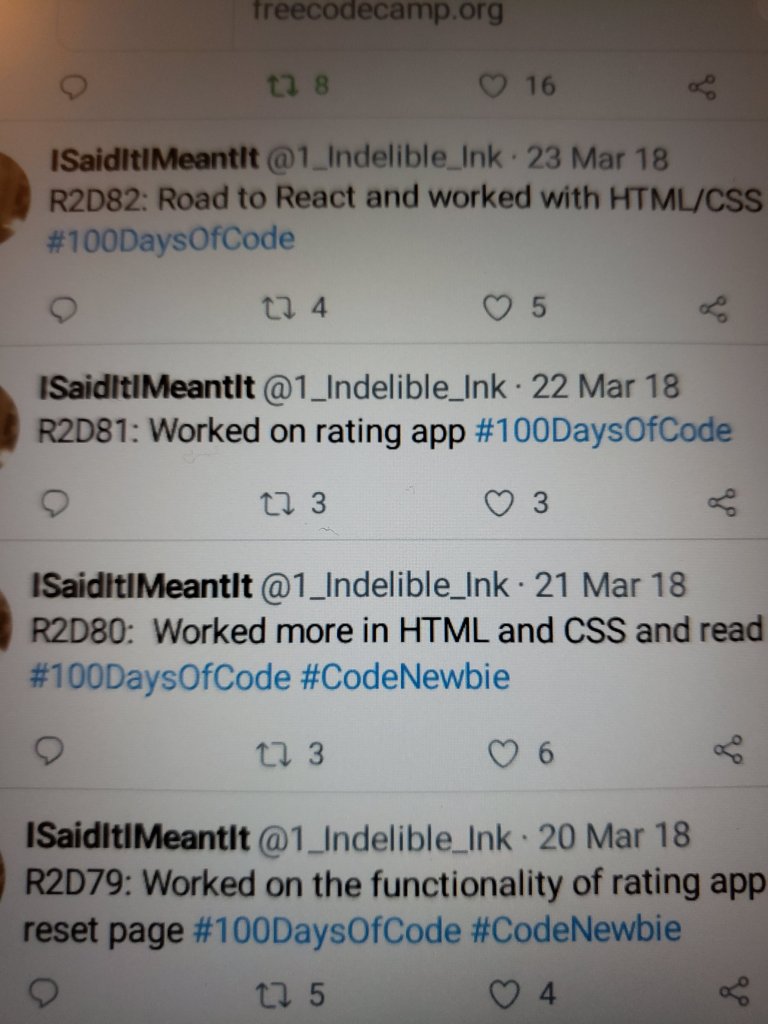
So, we talked about how structure and time are all warped in my head. Flashback to the #100DaysOfCode Challenge.

#100DaysOfCode is a challenge that designing to help people create a habit of coding on a daily basis. The thought is that by committing and posting daily on the things one did to further their coding goals the community works to hold each other accountable for fulfilling this commitment and meeting our personal goals.

I completed the challenge twice. Once, I was just moving towards doing a daily accountability and the second I focused on Javascript. The end result is that I completed the challenges , but it didn’t improve my habits. If nothing else having to complete it because I’d made a commitment kind of burned me out and at some points frustrated me to no end. I think for some it would create a habit and maybe if I had chosen a project to work on that I was passionate about it would have made it fun for me, but I didn’t and didn’t reflect enough about what I wanted and who I am to make a more informed choice before committing. If I was to do the challenge today I would probably concentrated on python for hackers/pentesters and writing scripts, because I think that would keep me interested, but I have a little too much on my plate currently to make that kind of commitment.

Repetition of the same thought or physical action develops into a habit which, repeated frequently enough, becomes an automatic reflex.

Norman Vincent Peale
def greet(name):
    print ('Hello', name)

greet('Jack')
greet('Jill')
greet('Bob')

I would recommend anyone to take up this challenge if they wanted to find a way to build habits. If you look on the site linked below it will show you that #100DaysOf_ can build habits in any number of subjects. I would just interject that if this is the choice to find something that is challenging and interesting enough to make you want to complete the challenge, not because it is a challenge, but because the project makes you passionate.
#100DaysofCode Site

Posted in Learning Woes

Time is the Enemy…

Don’t let Time Management be Your Greatest Foe…

I written about my troubles with time over and over, it’s a reoccurring theme. Time shouldn’t be one’s enemy, but sometimes it does feel like it is. I know that I have a strong procrastination streak and thus far it hasn’t hurt me,but I want to be better with my time, even if it was just to make myself feel a bit more organized.

I also believe that this is a personal concept. Time, can feel like a weight for some and for others making schedules and being on top of their time management can feel cathartic. For me, it’s a tad bit more anxiety-filling. Bullet notebooks and super strict schedules make me itch. I don’t think “habit-tracking” is for me.

Don’t get me wrong, I do work better when I know things are due and I’m responsible, but not when that makes these things micromanage my time and effort. I like knowing there is a date and then finishing whatever, whenever I’m ready by that date. I cannot do the daily scheduled work, it just makes things tedious and increases the pressure I already put on myself.

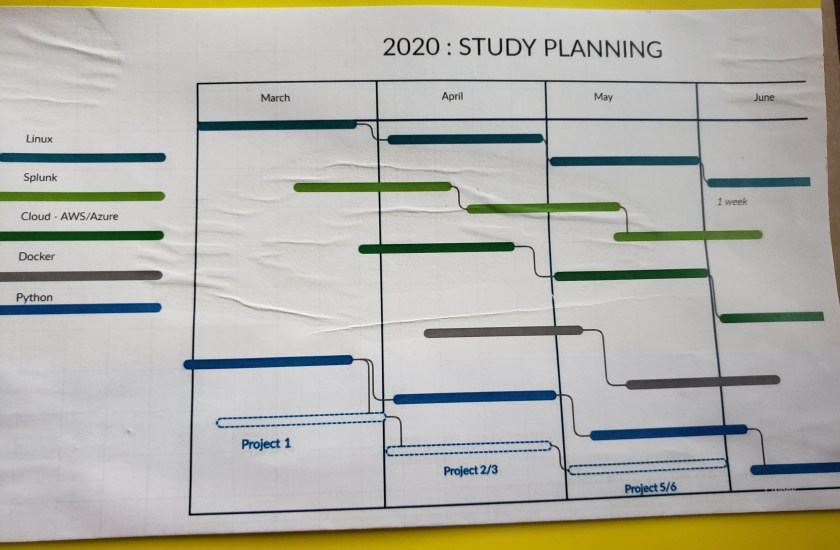
Which is why I came up with a nice little Gantt Chart for the 5 main things that I want to learn for the first halfish of this year. I only included things that I can find a certification for to judge my progress by. I only have the certification exam scheduled for Linux+ though; I bought that last year and have a hard deadline of September to take this exam, though I scheduled to take it Mid-July.


I do sometime wonder if the lack of a coherent tracking system is somehow holding me back from like “my full potential”. Other times I think that this works; the way I work works for me. It will not work for everyone or most, but it works for me. Besides, do I really need one more thing to try to learn and stress over?

Posted in Profiles

Profile in Cyber

“I think it’s very important to get more women into computing. My slogan is: Computing is too important to be left to men.” –

Karen Spärck Jones

Melba Roy Mouton

Was one of NASA’s “human computers” in the early space program. A graduate of Howard University from Virginia, Mouton headed a group of these “human computers” that tracked satellites. Furthermore, Mouton, was also a computer programmer at NASA. Her programs “predicted aircraft locations and trajectories.” (Women & Tech Project, 2014).

More on NaSA’s “Human Computers”:

1929 – June 25, 1990

References:
Posted in Music to Work to, Uncategorized, What I've Used

Music to Work to

Changing gears for a few posts.

There are many scholarly articles written regarding music and productivity. I know when I’m working noise helps me kind of focus and when I’m at work music helps to drown out other things. I actually spend a good deal of time listening to lessons or infographic shows, or historical bits because I’m kind of a nerd, but music aids my productivity. One of the best sounds I’ve found to listen to while working is Lofi Japanese HipHop or TripHop. I like sounds with heavy bass, but not having to think about words helps to just let the music be background.

In this occasional post series I’ll be sharing some of the music that aids in making me a more productive worker and/or helps me to study.

I really got into this type of sound while I was working overseas when I would listen to Arabic HipHop mixes. From there I branched out to this and as I stated above the lack of words makes me zoom into the sound and bop along as I type away.

Posted in Flashback Friday, Learning Woes

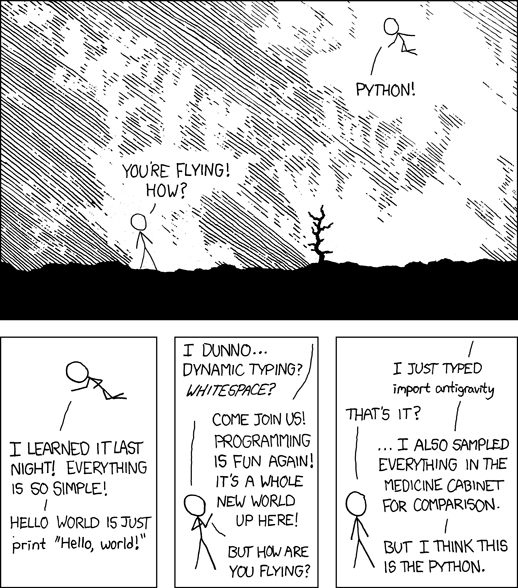
Python, I Can’t Quit You….

Hisss, Hisssss, Hisssssss.

I love Python. I admit, that when learning programming Python was not my first language. I started with web development, so I started with JavaScript after getting the hang of HTML5 and CSS3. I don’t hate JS, I just find the syntax structure more taxing in JavaScript. I at first believed that JavaScript was impossible, but really I have trouble with breaking down complex problems more due to wanting to jump right in then in not understanding how to do so–but this is a whole other post and we’re talking about Python!
No matter how far I go in my studies, I keep coming back to wanting to have a grasp on the Python language. I consider myself a Python enthusiast.
I think it’s the similarity to spoken/written language that makes this language appeal the most to me. There are numerous sources that recommend beginners start with Python as a programming language and I support this assertion, unless of course the goal is front-end web development, then of course one might want to do JavaScript.
I want to know enough about both aspects to be considered mildly dangerous and capable of utilizing either when necessary.
So, as I prep out a plan to re-familiarize myself with not only programming, but Python, I realize I really do love this language. I just need to get over the belief that setbacks are permanent. I’m not going to be the best at everything and it all isn’t going to come easy, that was how Programming hit me years ago and I know I got frustrated by feeling like I wasn’t progressing or at least not quickly enough, but hanging out in online programming groups I realized that we’re all googling out way to success, most of us aren’t wunderkind, and imposter syndrome is a daily struggle, but if it interests you, like really interests you probably pretty much going to always find a way back to doing it.

print("Hello, World!")
# Python program to check if  
# given number is prime or not 
  
num = 11
  
# If given number is greater than 1 
if num > 1: 
      
   # Iterate from 2 to n / 2  
   for i in range(2, num//2): 
         
       # If num is divisible by any number between  
       # 2 and n / 2, it is not prime  
       if (num % i) == 0: 
           print(num, "is not a prime number") 
           break
   else: 
       print(num, "is a prime number") 
  
else: 
   print(num, "is not a prime number") 
Posted in What I've Used

What I’ve Used 02/2020

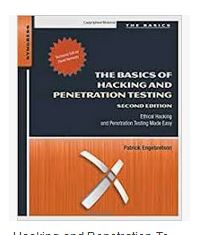
The Basics of Hacking and Penetration Testing – Second Edition
By: Patrick Engebretson [Syngress]

I started this book before finishing the class I took for Cyber Attack and Defense in which in pairs we had to work through penetration testing methodology on a machine chosen from Vulnhub. I just finished it a few days ago, not because it is in any way dense or hard to follow, but because of time management.
Regardless of my shortcomings, this book is exactly as the cover states: The basics.
This book is highly recommended a beginner guide for anyone who is new to hacking or penetration testing. The penetration testing methodology that I spoke of in a recent post is clearly laid out in this book and chapter by chapter Engebretson, walks-through these steps and explains the tools to use and the basic ways in which to use them. There are also chapters that delve into Web Application Hacking and a brief touch on Social Engineering with SET (Social Engineering Toolkit) which were very informative.
I found myself highlighting throughout this book to come back to quickly for my next CTF. It’s a good start into learning these tasks and is excellent in that it sticks with emphasizing a structured approach to penetration testing and hacking. It wouldn’t be good for people who have been doing these tasks for any length of time, but for the intended audience it is definitely worthwhile.

5/5

Cover Image